Traffic Signals
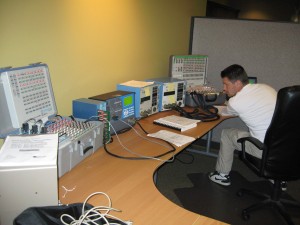
DMD undertake approximately one hundred (100) traffic signal design projects each year including new installations, upgrades and modifications. Our experience and expertise includes scenarios ranging from simple to complex as well as preparation and deployment of signal coordination and timing plans. In addition to signal design, we provide troubleshooting, inspection, conditions assessment and verification services and testing, set-up and commissioning of traffic controllers and related systems (see DMD “Testing, Set-up and Commissioning” services for more information).
From signal design standpoint we typically prepare plans, specifications and estimates. Drawings and specifications are to a high level of detail and quality to reduce often costly change-orders. As we undertake signal design for many municipals, governments and City’s we understand specific requirements and provide technical support and expert advise. As new and involving technologies and equipment are common in the traffic signal world DMD through hands on testing, set-up and commissioning and manufacturer training are able to assess and implement such new technologies and equipment.
DMD have too many projects to list so in lieu of listing projects attached information on our design services offered:
DMD Transportation Qualifications
DMD Traffic Signal and ITS Services
Beside design DMD are committed to improved efficiency. Traffic signals are part of ones day to day driving experience so they have a major impact on the travelers. As Cities grow and traffic increases the challenge is maximize the efficiency of ones traffic signals by reducing delays. In a survey undertaken by the US Federal Highway Authority, 50% of travelers noted signal timings should be improved and 36% noted signal timings should be checked more often. 47% of travelers surveyed believed that delays caused by congestion are a top community concern, and air pollution from vehicles a concern for 31%, all of which can be improved through better signal operation. This is significant as much can be done inexpensively to improve signal operation.
Improving signal operation is often a quick and inexpensive solution to reduce delays and driver frustrations. Cities often face a problem with lack of technical resources, staff reductions and limited budgets or rely on maintenance contractors who are focused on maintaining the system operation as opposed to improving it. Some traffic engineers offer traffic analysis aimed at refining traffic signal operation.
There is however is often a gap between those who do the analysis and those who understand the features of today’s sophisticated traffic controllers which are constantly evolving. Many knowledgeable with respect to traffic impact studies and capacity analysis often lack in understanding of the capabilities and features of today’s modern traffic controllers and traffic management systems. As a result, the operation of many signals can be optimized through simple timing changes and utilization of features within the traffic controllers. Today’s traffic controller have numerous features and options which are often not enabled or utilized.
DMD bridges this gap by offering traffic engineering services such as capacity analysis and signal timings coupled with our extensive knowledge of the traffic controller and signal design. We offer cost effective services to optimize signal operation and improve efficiency.
As opposed to often expensive traffic studies and reports which often collect dust on ones desk we are proposing inexpensive easy to implement “nut and bolts” refinements. To do this we would consult the owner to review operations, gather data from the controller and view signal operations on site. Once this is undertaken simple timing plan adjustments could be made and features activated to improve efficiency.
We can review features and options within the traffic controller and by enabling such features and options we can often improve operation, reliability and efficiency of the traffic signal. Time and time we find controllers are programmed for far less than optimal operation.
In the case of road corridors in area of high traffic volume or with high commercial development, the flow of traffic is typically only assessed in theoretical terms based on traffic counts run via a traffic modeling software. This is often time consuming and often not effective in optimizing traditional method of using traffic counts and signal timing and coordination software. To optimize signal timings DMD utilize arterial-based time-space and platoon progression diagram tool. This software allows one to drive the corridor and with the systems GPS device can actually record delay and develop time space model diagrams and thus refine signal timing and coordination plans. The software can be used to assess efficiency, refine timings and measure improvements. It is not uncommon to see improvement of 40%.
Recent project listed below involve signal timings and coordination are as follows:
City of Burnaby Hastings Street Traffic Signal Coordination
The Hastings St corridor is a major transportation link used by approximately 60,000 vehicles and day. During the rush hour periods the majority of the vehicles using this corridor are commuters traveling to and from the City of Vancouver. This was a major transportation route for traffic for the 2010 Olympic Winter games.
DMD were retained by the City of Burnaby Traffic Engineering Department to optimize signal timings and provide time based coordination of 18 existing traffic signals on 4.3km of the six lane commercial arterial roadway. The goal was to refine operation through signals timings refinements to reduce travel times in the AM and PM peaks.
To begin the project we consulted with the client to establish issues and concerns. We then recorded the corridor’s timings and delays by driving the corridor during both the AM and PM peak times on 10 separate occasions using Tru-traffic GPS based time space modeling software to measure current operations and performance. DMD then modeled the corridor using Synchro and optimized the traffic controller cycle length and timings for all 18 intersections. We then used Tru-Traffic time space modeling software to develop and optimize signal coordination plans. After implementing the timings on site,
DMD verified the coordination and measured the actual results by again driving the corridor as above utilizing Tru-traffic GPS based time space modeling software which recorded the actual travel time, delay, number of stops and fuel consumption as compared to the original runs. The result was an actual before and after real performance measure. The actual results were validated and were not theoretical as is the case with Synchro. Upon project completion, the City of Burnaby now has an optimized signal corridor operating to maximum efficiency. Comparing the pre and post coordination travel times though the corridor, the average driver now saves over 5 minutes when passing through the 18 intersections in the AM and PM peak times. This resulted in a 27% reduction in travel time along with the following environmental benefits:
- Total litres of fuel reduced by 746,329 litres per year, resulting in a savings of approximately $783,645.14 for Hastings Corridor drivers ($44.46 per driver)
- Greenhouse Gas (GHG) emissions reduced by approximately 1.8 million kilograms, equivalent to taking 1,295 vehicles off the road
- Equal to planting 10,883 trees to absorb GHG emissions
Lougheed Highway Signal Coordination, Burnaby, British Columbia
The Lougheed Highway signal corridor involves 10 Ministry owned signals on a major arterial road spread out over 3km. The corridor links two major bridges and is current very over-saturated.
To begin the project we consulted with the client to establish issues and concerns. We then recorded the corridor’s timings and delays by driving the corridor during both the AM and PM peak times on 10 separate occasions using Tru-traffic GPS based time space modeling software to measure current operations and performance.
DMD are now in the process of modeling the corridor using Synchro to optimize the traffic controller cycle length and timings for all intersections. We will then use Tru-Traffic time space modeling software to develop and optimize signal coordination plans. After implementing the timings on site, DMD will verify the coordination and measured the actual results by utilizing Tru-traffic software which recorded the actual travel time, delay, number of stops and fuel consumption. This will then be compared to the original operations.
Signal Coordination, District of North Vancouver, British Columbia
DMD were retained by the District of North Vancouver to optimize signal timings and provide time based coordination of 4 existing traffic signals on an arterial roadway. The goal was to refine operation through signals timings refinements to reduce travel times in peak periods.
To begin the project we consulted with the client to establish issues and concerns. We then recorded the corridor’s timings and delays by driving the corridor during both the AM and PM peak times using Tru-traffic GPS based time space modeling software to measure current operations and performance. DMD then modeled the corridor using Synchro and optimized the traffic controller cycle length and timings for all 4 intersections. We then used Tru-Traffic time space modeling software to develop and optimize signal coordination plans.
DMD staff input final signal and coordination plans in our shop and on site. The owner did not require before and after results so after performance measurements were not undertaken.
Transit Signal Priority, Richmond, British Columbia
DMD were retained by the hardware supplier Novax Industries as part of large turn-key project which involved design, supply and installation of Novax’s TransPod transit priority system. We provided traffic engineering services for a project aimed at refining transit operations in very congested area of the City of Richmond.
We provided an optimum transit system performance that encompasses both directions of travel along corridor. This proved to be a delicate balance between refining signal operations for transit vehicles while at the same time maintaining a high level of service for the general public. Any modifications to the timing plans had to be accepted by the stakeholders involved transit authority, City of Richmond, and Ministry of Transportation. Transit priority included features such as green extension, red truncation and special transit phases (queue jumping) with minimal impact on non-TSP traffic.
Our key responsibilities included:
- Review of transit signal priority (TSP) operation for two different traffic controller manufacturers. This ensured that the proposed TSP operation could be physically implemented in the existing infrastructure.
- Coordinated with stakeholders as required regarding approval for the recommended controller database changes for TSP operation.
- Coordinated with traffic controller suppliers regarding controller TSP operation.
- Defined best method of TSP operation (manufacturer specific or as per NTCIP 1211 Object Definitions for Signal Control and Prioritization)
- Analyzed existing controller databases and generated report on feasibility for TSP operation.
- Determined the time available in controller database to accommodate TSP operation for each timing plan currently used.
- Coordinated with stakeholders as required regarding approval for the recommended controller database changes for TSP operation.
- Determined available options to coordinate both directions of traffic to minimize delay to TSP buses.
- Generated timing and coordination plans for 5 intersections.
- Undertook validation of the TSP operation for the Econolite and Naztec controllers in lab for each intersection controller. The validation process was crucial in order to guarantee problem free commissioning/implementation.
- Generated reports and database printouts based on lab results and provided them to stakeholders for approval. Prepared signal timing sheets for approval.
- Generated report and database printouts based on lab results for stakeholder approval.
- Programmed controllers with approved TSP databases.
- Validated TSP check-in and check-out for one TSP plan at each intersection location.
- Provided report identifying the potential benefits of TSP operation for the transit vehicles and the impact on non-TSP transit vehicles and local traffic.We found the bus priority through an intersection had some negative impacts. If the signal head for the bus was to remain green until the bus cleared the intersection, other approaches resulted in larger queue build up, resulting in longer delays. The idling vehicles now are producing more GHG emissions then previously. In order to overcome any new delays introduced by TSP we redesigned the operation of the traffic signals by introducing overlaps, add coordination with adjacent signals, as well as used volume density to reduce the delays on other non TSP approaches. Special attention was given to areas of congestion. All these upgrades resulted in reduced impacts and improved traffic flow.
If specific information for work undertaken in specific City or jurisdiction is required then contact DMD directly.
NEMA TS2 Type 1 Cabinet Assembly Specification
The Ministry of Transportation and Infrastructure (MoTI)
of British Columbia (BC) have been using NEMA TS1 traffic controllers and cabinet assemblies to control the traffic signals within the Province of BC.
The MoTI were interested in transitioning to the NEMA TS2 Type 1 platform for future signal installations. DMD was contracted to provide a cabinet design and specification that conforms to the NEMA TS2 Type 1 standard, while also encompassing any special MoTI requirements.
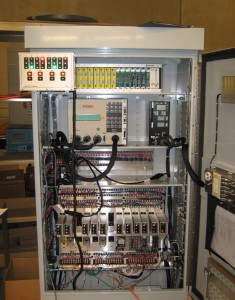
Due to the required capacity of the Terminals and Facilities (T&F) and Vehicle Detection, a Size 6 cabinet assembly was selected. The Terminals & Facilites is capable of providing outputs for 48 signal circuits for signal control and 10 flasher circuits for emergency flash and advance warning applications. Vehicle detection capabilities consist of up to thirty-two channels of inductive loop vehicle detection and capacity for up to 8 video detection cameras, providing a maximum of 64 channels of detection. In addition to emergency and transit signal priority preemption inputs, capability was added to accommodate both six wire and eight wire rail preemption controls.
Cabinet assembly enhancements include increased availability of inputs and output terminals, a solid state mercury contactor, high intensity LED cabinet lighting, heating and cooling controls with digital readout, two cabinet fans and Positive Temperature Co-Efficient cabinet heater.
Individual low current circuit breakers provide power to the Camera, Communications and Preemption interface panels. Different stages of surge protection were also provided for the control equipment in the cabinet.
The new cabinet design and specification meets the current needs for traffic control on the highways within BC as well as providing a platform for future expansion.
City of Burnaby Signal Emergency Vehical Pre-emption
The City of Burnaby is equipping all of the traffic signals and emergency vehicles within the city with an
emergency vehicle and transit signal priority control system. This system will provide faster response times for fire and police
departments and has the capability to reduce transit vehicle travel times. The project involves approximately 230 intersections
and over 200 emergency vehicles.
Through a competitive selection process, DMD was retained to manage the installation and provide system integration for this project. DMD are
responsible for mapping all of the approaches for the GPS based preemption system as well as program the priority control system
equipment. The project also involves programming the traffic control equipment and operational testing for the approximately 230
signalized intersections. The project is expected to be completed by the end of 2009.
Border Infrastructure Project - Highway 10 from 120St to 176St, Surrey, BC
The Border Infrastructure Program (BIP) is a jointly funded federal-provincial initiative to improve the movement of goods to and from the Lower Mainland’s four border crossings. The five-year, $210–million program will improve key sections of the region’s road network resulting in better links between border crossings, ports, container facilities, industrial parks, airports and railways. The program consists of upgrading three main highway corridors in the Vancouver Lower Mainland area: Highway 10, Highway 15, and Highway 91/91A.
Why is the Border Infrastructure Project important to the B.C. economy? Over 1.3 million trucks cross the BC/U.S. border each year. The Highway 15 border crossing in Surrey handles 4,000 trucks a day. The value of goods transported by trucks across the BC-.U.S. border exceeds $24 billion annually. Road congestion drives up costs and hurts BC’s competitiveness. A recent survey of BC and Washington truckers estimated that border crossing congestion costs operators $60 million a year. Roads serving the Lower Mainland’s border crossings do not operate at peak efficiency.
DMD working as sub-consultant to UMA Engineering undertook traffic signal and roadway lighting designs, web camera designs, interfaced with railway crossing signal designers, undertook Synchro traffic analysis, defined signal phasing and timings plans and signal coordination plans for the the entire Highway 10 corridor. The project included a unique at grade diamond interchange traffic signal design, coordination with BC Hydro and the Ministry of Transportation, traffic controller testing, video vehicle detection and prepare railway pre-emption timing plans using TexDoT method.
Project Map (this file is approx. 5.3 Meg)
Contact DMD
DMD & Associates Ltd
- #12-17358 104A Ave.
- Surrey BC V4N 5M3
- Canada
- Tel: +1 604-589-9010
- Toll Free: +1 877-249-8080
- Fax: +1 604-589-9012
- Email: info@dmdeng.com
- Map
Pacific Northwest PO Box
- 1770 Front St., PMB #267
- Lynden WA 98264
- USA
Arizona
- 4700 South Fulton Ranch Blvd #77
- Chandler AZ 85248
- USA
- Toll Free: +1 877-249-8080